
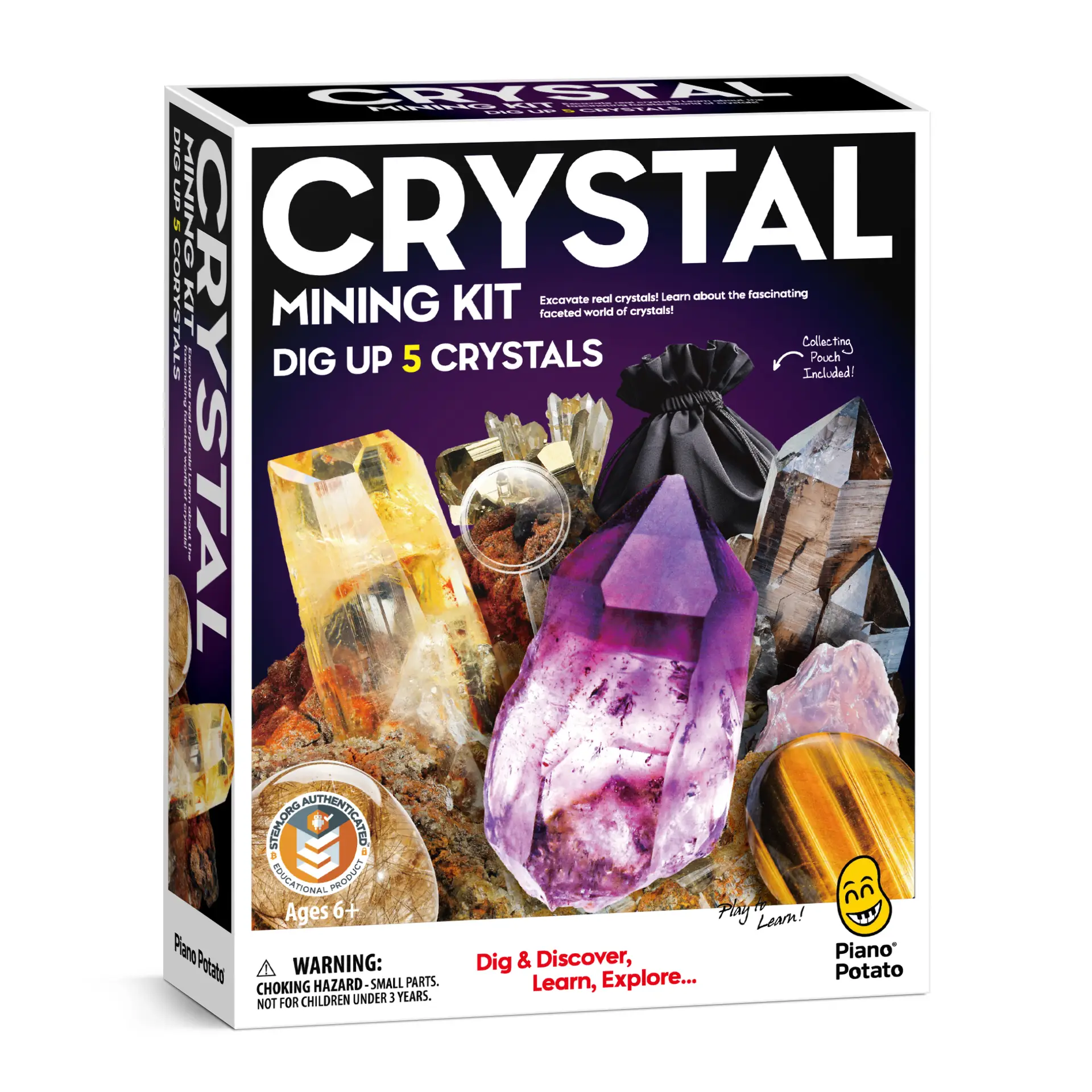
Open a gem dig kit and you will usually find an excavation block made from plaster or a similar material that can be chipped or scraped away. Hidden inside may be rough minerals, polished stones, quartz varieties, gemstone materials, fossils, charms, or other themed surprises. The exact contents vary by manufacturer, product theme, kit size, and intended age group.
Before looking at individual specimens, it helps to understand that the terms crystal, mineral, gemstone, and rock can overlap. Quartz is a mineral with an ordered crystal structure; amethyst and citrine are quartz varieties that are also used as gemstones; and lapis lazuli is a rock composed mainly of lazurite, calcite, and pyrite rather than a single mineral.[1][2][3][4]
The word real also needs careful interpretation. A specimen may be a natural mineral, a treated natural material, a laboratory-grown material, or an imitation. GIA defines synthetic gem materials as laboratory-made materials that share virtually all of the chemical, optical, and physical characteristics of their natural mineral counterparts, although exceptions exist. An imitation, by contrast, is a different material used to resemble another gem.[5]
A treated natural stone began as natural material but has undergone a process intended to alter properties such as color, clarity, or durability. Treatments can include heating, irradiation, dyeing, coating, impregnation, bleaching, or fracture filling, depending on the material.[6]
For parents and teachers, a gem dig kit can therefore contain several distinct types of discoveries:
| Minerals and crystals | Natural or manufactured specimens that can be examined for color, luster, transparency, crystal form, fractures, and inclusions. |
| Gemstone materials | Minerals or rocks valued for properties such as appearance, durability, rarity, or suitability for cutting and polishing. |
| Fossils or fossil replicas | Items connected with ancient life and geologic history. |
| Themed accessories | Charms, pendants, treasure maps, cards, stickers, or other play components. |
| Digging and observation tools | Items such as a chisel, brush, magnifier, goggles, display stand, or identification guide. |
Not every kit contains every category, and terms such as “real gemstone” should not be assumed to mean rare, untreated, flawless, jewelry-grade, or highly valuable. The specific product description should always be checked for the actual contents.
Crystals and Mineral Specimens
Clear Quartz
Quartz is one of the world’s most common minerals and is widely used in educational mineral collections. It has the chemical formula SiO₂, a Mohs hardness of 7, a generally vitreous luster, and can range from transparent to nearly opaque. Quartz commonly shows conchoidal fracture and is classified as brittle, although massive forms can be relatively tough.[1]

Mohs hardness describes resistance to scratching, not resistance to breaking. A quartz specimen can therefore be hard enough to resist scratching by many softer materials while still developing chips, sharp points, or fresh fracture surfaces if struck or dropped.[1]
Natural quartz also varies considerably in appearance. A specimen may be clear, cloudy, milky, translucent, internally fractured, or contain visible inclusions. Its surface can be smooth, irregular, naturally fractured, or partly covered with material from the surrounding host rock. These differences are not, by themselves, evidence that a stone is fake or defective.
Children can compare several quartz specimens by observing:
- transparency and translucency;
- surface luster;
- crystal faces and fracture surfaces;
- internal cracks and visible inclusions;
- differences between rough and polished surfaces.
This type of comparison introduces an important scientific idea: specimens of the same mineral do not always look identical.
Amethyst, Rose Quartz, and Citrine
Amethyst, rose quartz, and citrine are all quartz varieties, but their appearance and color should not be explained as though every colored specimen results from a single universal mechanism.
Amethyst is the purple variety of quartz. GIA lists its chemical composition as SiO₂, its Mohs hardness as 7, and its refractive index as 1.544 to 1.553.[2]
Rose quartz ranges from almost white to medium-dark pink. GIA notes that microscopic mineral inclusions can give rose quartz its characteristic cloudy translucence. Like other quartz varieties, it has a Mohs hardness of 7.[7]
Citrine is a transparent yellow to brownish-orange variety of quartz. Natural citrine is comparatively rare, and GIA states that most citrine on the market results from heat treatment of amethyst.[3]
These examples show why bright color alone cannot prove that a specimen is natural and untreated. Gem materials can be heated, irradiated, dyed, coated, impregnated, bleached, or otherwise treated to change their appearance or durability.[6]
Color alone cannot prove that a stone is natural, untreated, valuable, or correctly identified.
Rough Stones, Polished Stones, and Crystal Clusters
Specimens in excavation kits commonly appear in several physical forms:
- Rough pieces, which may retain natural fractures, uneven surfaces, host-rock material, or partial crystal faces.
- Polished or tumbled stones, whose projecting edges have been rounded and whose colors or patterns may be easier to see.
- Crystal clusters, in which multiple crystals or crystal points occur together.
Physical form should not be confused with mineral identity. A rough stone and a polished stone can be the same mineral, while two specimens with similar shapes can be entirely different materials.
A magnifier can reveal useful features such as crystal faces, inclusions, fractures, grain boundaries, bubbles, banding, or surface marks. However, no single visual feature provides a universal authenticity test. Some natural specimens lack obvious crystal faces or growth marks, while synthetic or imitation materials can also contain inclusions, bubbles, lines, or irregularities.
Some treatments are difficult to identify even for experienced gemologists and may require examination by a qualified gemological laboratory using magnification or more advanced analytical techniques.[6]
Gemstone Materials
Does an Affordable Stone Have to Be Fake?
No. The small stones found in children’s kits may include rough fragments, tumbled stones, lower-clarity specimens, ornamental materials, or naturally abundant minerals. Such material can be genuine while still having relatively little commercial value.
A stone’s value depends on factors such as its identity, size, color, clarity, transparency, treatment history, cut, rarity, condition, origin, and market demand. The fact that a specimen is inexpensive does not by itself establish that it is artificial.
A more useful set of questions is:
- Is the specimen a natural mineral or rock?
- Has it been treated?
- Was it grown in a laboratory?
- Is it an imitation made from another material?
- Does the product description clearly disclose what is included?
GIA notes that a synthetic gem material is produced in a laboratory but shares virtually all of the chemical, optical, and physical characteristics of its natural counterpart, subject to limited exceptions. This is different from an imitation, which merely resembles another gem material.[5]
Common Materials That May Appear in Kits
The exact selection varies by product, but educational and excavation kits may include quartz varieties and other ornamental gem materials such as:
| Clear quartz | Colorless to cloudy quartz with Mohs hardness 7. |
| Amethyst | The purple variety of quartz. |
| Rose quartz | A pink quartz variety commonly showing translucent or cloudy material. |
| Citrine | A yellow to brownish-orange quartz variety; much commercial citrine is produced by heating amethyst. |
| Agate, chalcedony, jasper, or similar ornamental silica materials | Materials that may occur in many colors and patterns and may sometimes be treated or dyed. |
| Lapis lazuli | A rock composed mainly of lazurite, calcite, and pyrite rather than a single mineral. |
GIA identifies lapis lazuli specifically as a rock consisting principally of lazurite, calcite, and pyrite, illustrating why not every material commonly called a gemstone is a single mineral species.[4]
Why Appearance Can Be Misleading
The same mineral can occur in different colors, while unrelated materials can look similar. Lighting conditions also affect perception: a specimen may look different under daylight, warm indoor lighting, cool LEDs, a phone flashlight, or against different backgrounds.
Surface finish matters as well. Polishing changes how light interacts with a stone and can make color, pattern, and translucency easier to see. A rough and polished specimen of the same material may therefore appear surprisingly different.
Treatment adds another complication. GIA reports that dyeing has been used on gem materials including chalcedony, quartz, lapis lazuli, turquoise, and others. Some dyes may be affected by alcohol or acetone, and some can fade after prolonged exposure to sunlight.[6]
Because solvents can remove some dyes or damage treated materials, acetone, alcohol, acids, and similar chemicals should not be presented as routine children’s identification tests. Visual comparison, magnification, sorting, and reference cards are more appropriate for a basic educational activity.
Fossils and Fossil-Themed Finds
Some excavation kits contain fossils, fossil fragments, replicas, or fossil-themed models. Examples may include ammonites, shark teeth, shells, trilobites, or other recognizable forms, depending on the product.
Fossils are evidence of ancient life and provide records of Earth’s biological and geological history.[8]
The age of a specific fossil cannot be determined reliably from its general appearance or common name alone. More precise scientific interpretation depends on factors such as biological identification, locality, geological formation, surrounding rock layers, and stratigraphic context.
For example, the label “shark tooth” does not describe a single age because sharks have existed through many different geological periods. Likewise, ammonites and trilobites represent broad groups that occurred across long intervals of geologic time.
The scientific value of a fossil therefore depends not only on what the object looks like but also on where it came from and the geological context in which it was found.
When a kit includes fossil-related items, the product description should ideally make clear whether each object is:
- an authentic fossil;
- a fossil fragment;
- a cast or replica;
- or a decorative model inspired by a fossil.
A fossil discovery can introduce questions such as:
- What kind of organism produced it?
- Which part of the organism was preserved?
- Was the organism marine or terrestrial?
- How does fossilization occur?
- How do scientists determine geological age?
- Why are many fossils incomplete?
Themed Surprises and Accessories
Some gem dig kits extend the activity beyond minerals and fossils by including themed accessories. Depending on the product, these may include:
| Pendants or charms | Small wearable or decorative components. |
| Ring bases or bracelet parts | Components for simple craft or jewelry-style activities. |
| Treasure maps | Paper accessories that extend the activity into imaginative play. |
| Identification cards | Reference materials for comparing specimen names, colors, textures, and basic properties. |
| Stickers or themed cards | Decorative additions that vary by product theme. |
These items are not standardized across all gem dig kits. A kit containing one type of surprise does not necessarily include the others, and accessories may either be hidden inside the excavation block or packaged separately.
Digging and Observation Tools
A gem dig kit may include some combination of:
- a plastic digging chisel;
- a small brush;
- a magnifier;
- protective goggles;
- a display stand or base;
- an identification or instruction guide.
The tools should be suitable for the excavation material and intended age group. A plastic chisel may be designed to scrape or chip a relatively soft block, but tool safety should not be judged simply by comparing Mohs hardness values. The Mohs scale describes resistance to scratching in minerals; it does not fully describe impact behavior, bending, sharpness, fracture, or how a plastic tool interacts with plaster.
Children should use controlled scraping and chipping rather than aggressive striking. If the manufacturer’s instructions recommend lightly wetting the excavation block, doing so may help soften certain materials or reduce airborne dust. The instructions for the specific kit should always take priority.
Eye protection is sensible when excavation can generate dust or small flying particles. Care is also needed after excavation because natural mineral pieces can have pointed corners, chipped surfaces, or sharp fracture edges.
Age Recommendations and Small-Part Safety
Age suitability should not be determined only by the length of a play session or the presence of adult supervision. Small stones, beads, charms, rings, detachable accessories, or pieces that can break off may create choking, aspiration, or ingestion hazards.
The U.S. Consumer Product Safety Commission states that children’s products intended for use by children under three that present choking, aspiration, or ingestion hazards because of small parts are banned hazardous substances under 16 CFR Part 1501. The CPSC also explains that certain children’s products containing small parts may require choking-hazard warnings.[9]
In the European Union, toy-safety requirements address general health and safety risks as well as specific physical and mechanical, flammability, chemical, electrical, hygiene, and radioactivity risks.[10]
For parents and caregivers, practical precautions include:
- follow the product’s official age recommendation;
- read the instructions and warnings before use;
- check for small parts and detachable accessories;
- provide appropriate supervision;
- use eye protection when dust or flying particles are possible;
- do not allow stones or accessories to be placed in the mouth;
- watch for sharp natural fracture edges;
- avoid unsupervised chemical testing;
- clean the work area after excavation;
- keep small specimens away from younger siblings.
What Can Children Learn After the Dig?
The excavation itself is only the first stage. After specimens are removed and cleaned according to the product instructions, children can sort and compare them using observable characteristics.
Useful follow-up activities include:
- grouping specimens by color or pattern;
- comparing rough and polished surfaces;
- sorting transparent, translucent, and opaque materials;
- examining specimens with a magnifier;
- looking for crystal faces, fractures, inclusions, grains, or banding;
- drawing or photographing individual specimens;
- comparing finds with an identification card;
- recording questions that cannot be answered from appearance alone.
One of the most useful scientific lessons is that identification requires evidence. A purple stone is not automatically amethyst, a glassy-looking material is not automatically glass, a visible bubble does not by itself prove that a specimen is artificial, and a cloudy or fractured stone is not necessarily fake.
Likewise, observations made with the naked eye or a simple magnifier can help narrow possibilities but may not provide a definitive identification. GIA notes that some gemstone treatments are difficult to distinguish even for experts and may require laboratory examination.[6]
So, What Is Actually Inside a Gem Dig Kit?
Most gem dig kits combine an excavation block with hidden specimens and basic digging tools. Depending on the product, those specimens may include natural minerals, quartz varieties, polished stones, gemstone materials, fossils, replicas, charms, maps, cards, or other themed accessories.
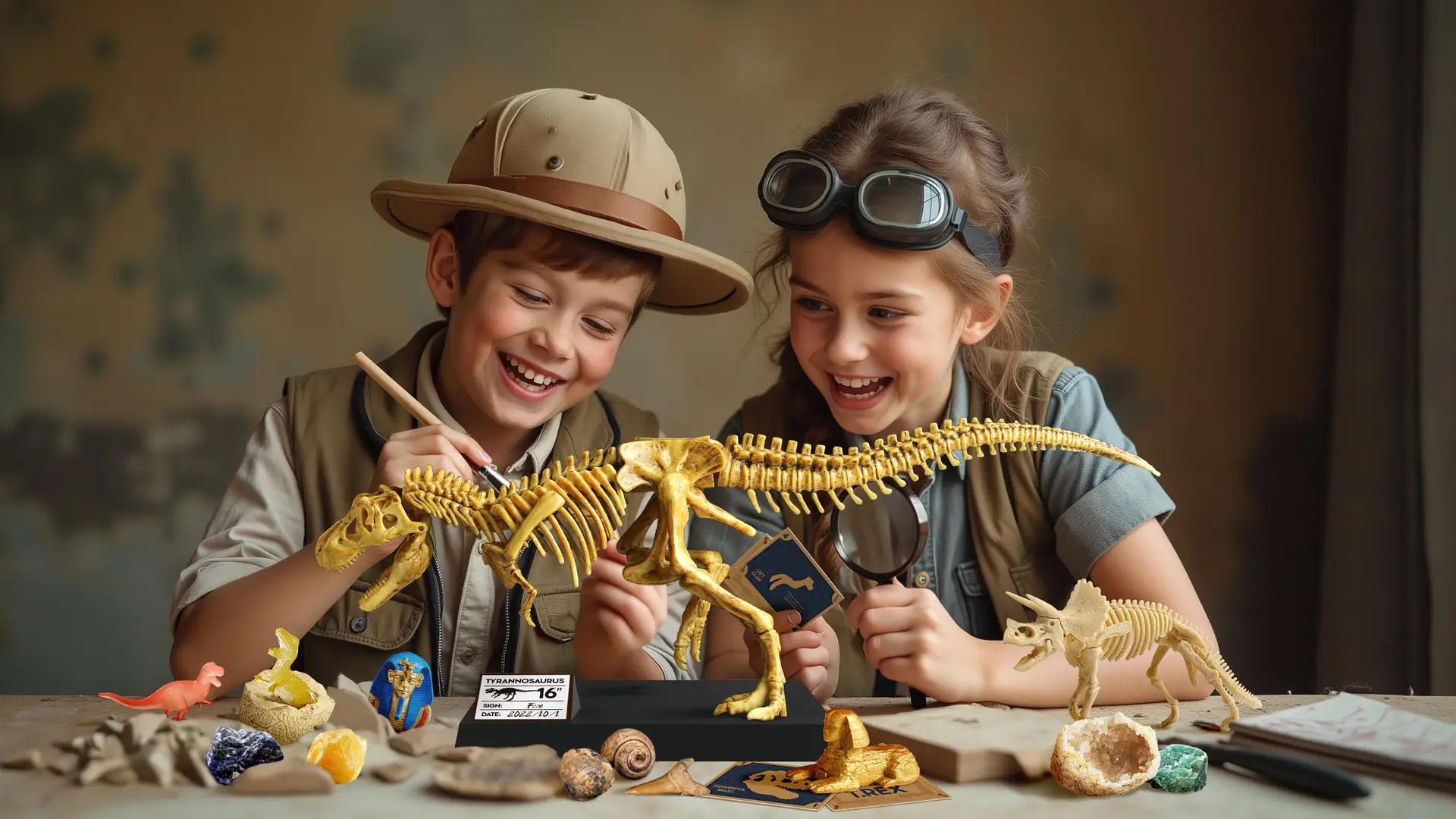
The exact contents can differ substantially from one kit to another. For that reason, buyers should look beyond broad claims such as “real gems inside” and check how clearly the product identifies its materials.
Useful questions include:
- Are the specimens identified by name?
- Are they natural, treated, synthetic, imitation, or replica materials?
- Can the contents vary from box to box?
- If fossils are included, are they authentic specimens, fragments, or replicas?
- Are themed surprises guaranteed or only possible inclusions?
- What is the official age recommendation?
- Are there small-part or choking-hazard warnings?
- Can excavation generate dust or flying particles?
- Are instructions provided for cleaning and identifying the specimens?
For children, the most valuable part of the activity is not simply finding the brightest or prettiest stone. It is learning to compare specimens, recognize natural variation, ask why similar materials can look different, understand why appearance alone may not prove identity, and distinguish among natural, treated, synthetic, imitation, and replica materials.
That is how a simple excavation activity can become an introduction to geology, paleontology, observation, evidence, and scientific thinking.