
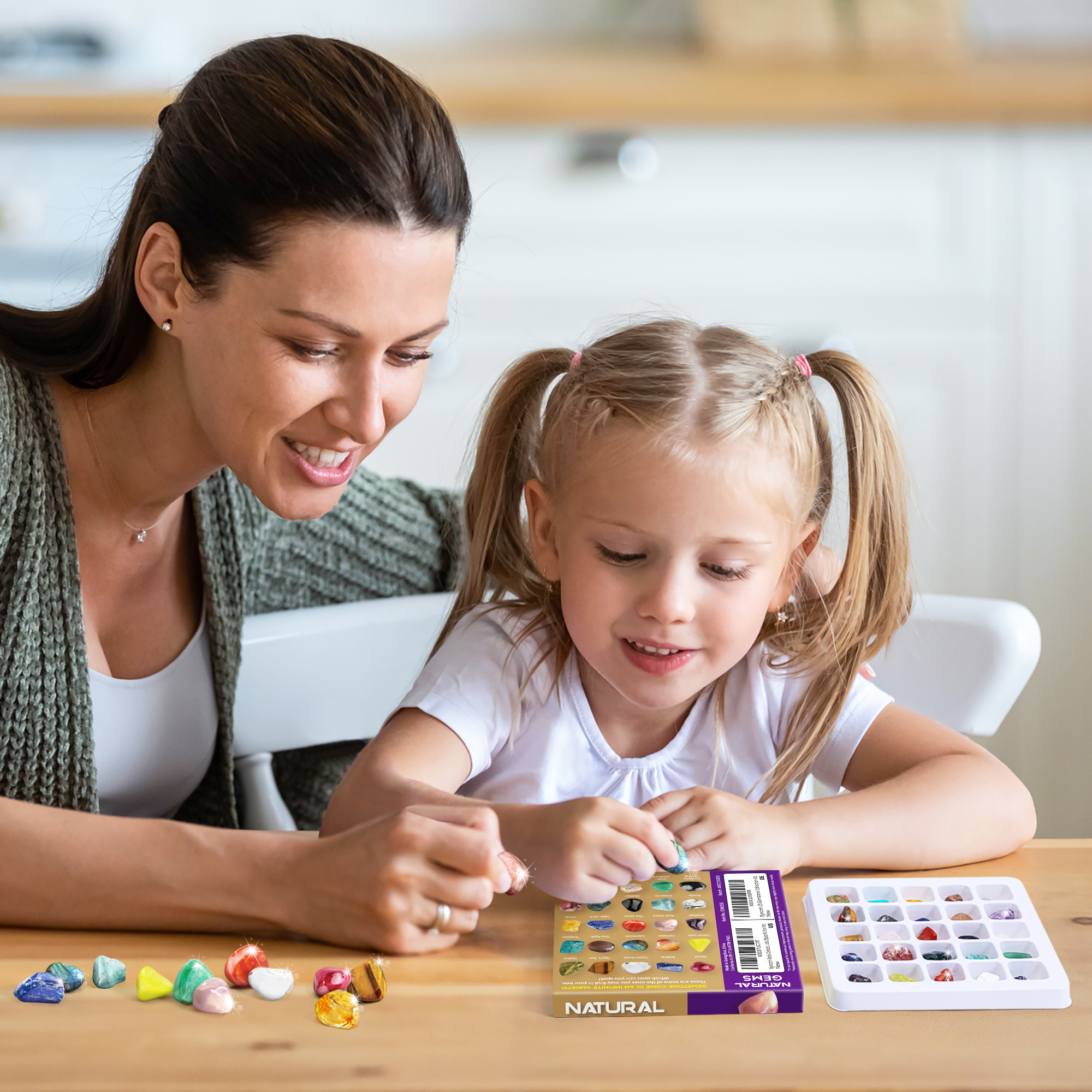
The American Academy of Pediatrics recommends developmentally appropriate toys that support imagination, problem-solving, interaction, and active play instead of relying on “educational” claims printed on the package.[1]
Open-Ended Toys vs. Step-by-Step Kits
| Question | Open-Ended Toy | Step-by-Step Kit |
|---|---|---|
| Who chooses the goal? | Mostly the child | Mostly the kit |
| Main activity | Build, combine, change, pretend | Follow, assemble, make, experiment |
| Expected result | Many possible results | Usually one defined result or process |
| Best fit | Repeated, flexible play | A specific project or skill |
| Reuse | Usually high when parts can be rearranged | Depends on what remains after the project |
| Adult role | Usually joins in or gives prompts | May prepare materials, explain steps, or supervise tools |
| Consumables | Often low for building toys, but higher for art materials | Common in craft, science, and excavation kits |
Choose Open-Ended Toys When the Child Already Makes Their Own Plans
An open-ended toy does not have one “correct” finished result. Blocks, clay, plain art supplies, figures, pretend-play toys, and reusable construction systems can all fit this style.
A block might become a bridge today, a shop counter tomorrow, and part of an animal enclosure five minutes later. The child decides what they are trying to make, tests it, then changes the idea when it falls over.
The AAP links developmentally appropriate play with language, cognitive, social-emotional, self-regulation, and executive-function development.[2]
Open-ended toys usually suit children who already:
- build without copying a model;
- mix pieces from different toys;
- take finished designs apart and change them;
- invent their own stories or rules;
- keep trying after an idea fails.
A building toy is not automatically open-ended. Look at whether the parts can be separated, rearranged, mixed in new ways, and used without the instruction book. That is an important difference when comparing building STEM toys.
Choose a Step-by-Step Kit When the Child Wants a Clear Result
A step-by-step kit gives the child a goal and a sequence for getting there.
That includes excavation kits, crystal-growing sets, model kits, jewelry projects, painting kits, simple electronics, and science experiments.
This format works well for a child who says, “I want to grow a crystal,” “I want to dig up a dinosaur,” or “I want to build this model.” They do not have to invent the activity before they can start.
The CDC recommends child-led play with materials such as blocks, crayons, and paper because children can direct the activity themselves.[3] A structured kit starts from the other end: the first task is already decided, so the child can focus on doing it.
That is how many Fun & Science kits work. The kit supplies the process or question instead of asking the child to invent one first.
Look at What Is Left After the First Project
A one-project kit is not necessarily a one-use purchase. Useful tools, specimens, components, or skills may still be there after the main activity is finished.
Check whether the child can:
- reuse the tools;
- rebuild the parts;
- repeat the activity with replacement materials;
- change the original design;
- use the finished object in another activity;
- use the same technique without the original kit.
The Amber Dig Kit, for example, includes six insect resin specimens, one natural amber piece, digging tools, a picture guide, a storage pouch, and two necklace cords. The excavation block is used up, but the specimens and tools stay.
The same question helps when comparing science experiment kits and STEM building kits. Experiment materials may disappear after use, while building pieces often stay reusable. A science kit can still have long-term value if the tools, specimens, or procedures can be used again.
Choosing kits for a store, school, or activity program?
Send the age range, participant count, activity type, target market, and whether you need reusable or consumable kits. That gives you a much tighter shortlist before you compare individual products.
Check Who Is Really Doing the Activity
Some kits look child-friendly on the box, but an adult ends up doing most of the interesting work.
Read the instructions and check:
- who measures;
- who assembles;
- who uses the tools;
- who reads and understands the instructions;
- who fixes mistakes;
- who handles materials that need supervision.
If the adult is doing most of those jobs, treat it as a parent-and-child project rather than independent play.
Setup matters too. A kit may still need water, scissors, measuring cups, batteries, charging, table protection, household ingredients, or adult assembly before anything fun starts.
Break the total project time into:
- setup;
- hands-on child activity;
- adult-only work;
- waiting, drying, cooling, growing, or setting;
- cleanup.
A crystal-growing project may last several days, but the child might only spend a few short periods actively working on it. “Three-day project” does not mean three days of play.
Look at Pieces, Consumables, Refills, and Cost Together
A big piece count can sound impressive and still tell you almost nothing about the activity.
A 120-piece building set might contain 120 actual building components. A 120-piece craft kit might count every bead, sticker, string, brush, and storage item separately.
Break the contents into:
- core activity parts;
- tools;
- consumables;
- decorations;
- storage items;
- instructions.
For Arts & Crafts kits, check how many complete projects the included paint, beads, paper, molds, cords, or other consumables can actually make.
Typical consumables include paint, clay, plaster, paper, glue, experiment ingredients, crystal-growing material, excavation blocks, beads, and cords.
Also check whether replacements are proprietary. Ordinary paper, paint, glue, and string are easy to replace. A custom refill that only works with one kit may be harder or more expensive.
For a reusable toy:
Cost per use = purchase price ÷ realistic number of uses.
For a consumable kit:
Total cost = kit price + refills + required materials not included in the box.
Be realistic about reuse. Base it on what the child usually does with similar toys, not on the maximum number of uses a manufacturer could theoretically claim.
Check Whether Mistakes Can Be Fixed
Some activities are easy to undo. Others are not.
Blocks can usually be taken apart and rebuilt. Cut paper, hardened plaster, mixed experiment ingredients, stickers, and painted surfaces are much less forgiving.
For a child who gets upset by permanent mistakes, look for:
- extra materials;
- practice pieces;
- parts that can be detached;
- washable materials where suitable;
- instructions that show how to recover from common errors.
For Siblings and Groups, Count Workstations Instead of Pieces
A huge piece count does not mean several children can play at once.
If there is only one excavation block, one mold, one brush, or one main project base, everyone may still be waiting for a turn.
For group use, check:
- how many tools are included;
- how many separate work areas are possible;
- how much core material each child gets;
- whether children can work at the same time;
- whether every child ends up with their own result.
That tells you far more than the total number of components when buying for siblings, classrooms, parties, clubs, or group activities.
Do Not Buy a Toy Just Because It Says “STEM” or “Educational”
The AAP notes that many developmental claims used in toy marketing are not backed by credible scientific evidence.[4]
Forget the label for a minute and list what the child actually does.
Do they:
- build;
- measure;
- compare;
- observe;
- predict;
- test;
- identify;
- redesign;
- use a tool;
- explain a result?
If the adult performs the experiment while the child mainly watches, the word “STEM” on the box does not change the child’s role.
The same idea applies when comparing STEM and STEAM toys. Judge the activity, not the category name.
Use Safety as a Hard Filter
The U.S. Consumer Product Safety Commission advises families to follow age guidance and choose toys that match a child’s abilities and interests.[5]
CPSC rules restrict small parts in products intended for children under three because of choking, aspiration, and ingestion risks.[6]
Check kits for:
- small removable pieces;
- beads or small balls;
- magnets;
- button or coin batteries;
- sharp tools;
- long cords;
- projectiles;
- heated components;
- chemicals or mixtures that need supervision.
CPSC warns that swallowed high-powered magnets can attract through internal tissue and cause serious intestinal injury.[7]
Button and coin batteries are another serious hazard. If swallowed, they can cause severe internal burns, so the battery compartment needs to stay securely closed.[8]
If a younger sibling can get to the toy, judge the hazards for that child too.
Piano Potato’s product safety information explains its inspection process and use of independent testing laboratories. For any individual product, follow its specific age, warning, and supervision instructions.
Use This Checklist Before Buying
- Goal: Does the child want to invent something or finish something specific?
- Participation: Which steps can the child actually do?
- Instructions: Are the reading level, tools, and sequence manageable?
- Reuse: What can still be used after the first project?
- Consumables: What gets used up?
- Refills: Can those materials be replaced?
- Setup: What has to be prepared before the activity starts?
- Active time: How much time is real hands-on play?
- Mistakes: Can the child undo or correct an error?
- Sharing: Can several children participate at the same time?
- Storage: Where will reusable parts and unfinished projects go?
- Safety: Do the age label, small parts, tools, magnets, batteries, and supervision needs fit your household?
Building a retail, school, or activity-kit assortment?
Compare products by age range, reusable parts, consumables, tools, group-use format, and packaging needs before getting lost in individual designs.
Finally
Open-ended toys suit children who naturally invent, rebuild, and change the goal as they play. Step-by-step kits work better when the child wants a specific result or needs guidance with a new skill. Before buying either one, look at who does the work, what gets used up, what can be reused, how easy mistakes are to fix, and whether the safety requirements suit every child who can reach the toy.