
A screen-free science toy should still work if the phone or tablet stays in another room. An optional QR code or video is fine. The activity itself should not depend on it.
The American Academy of Pediatrics recommends making room for sleep, outdoor play, hobbies, family interaction, and other activities instead of treating screen use as just one number to track.[1]
Dig Kits, Experiment Kits, and Science Crafts
| Type | Best Fit | What the Child Does | Check Before Buying |
|---|---|---|---|
| Dig kits | Fossils, dinosaurs, rocks, collecting | Excavate, clean, identify, sort | Small specimens, dust, tools, identification material |
| Experiment kits | Mixing, testing, measuring, comparing | Change a condition and compare results | Distinct experiments, consumables, extra supplies, safety instructions |
| Science crafts | Building, painting, molding, making | Make an object, then test or inspect it | Whether the science is part of the activity or just part of the packaging |
Piano Potato groups related products into Dig & Explore, Fun & Science, Arts & Crafts, and Earth & Space.
A Dig Kit Should Not End the Moment the Object Appears
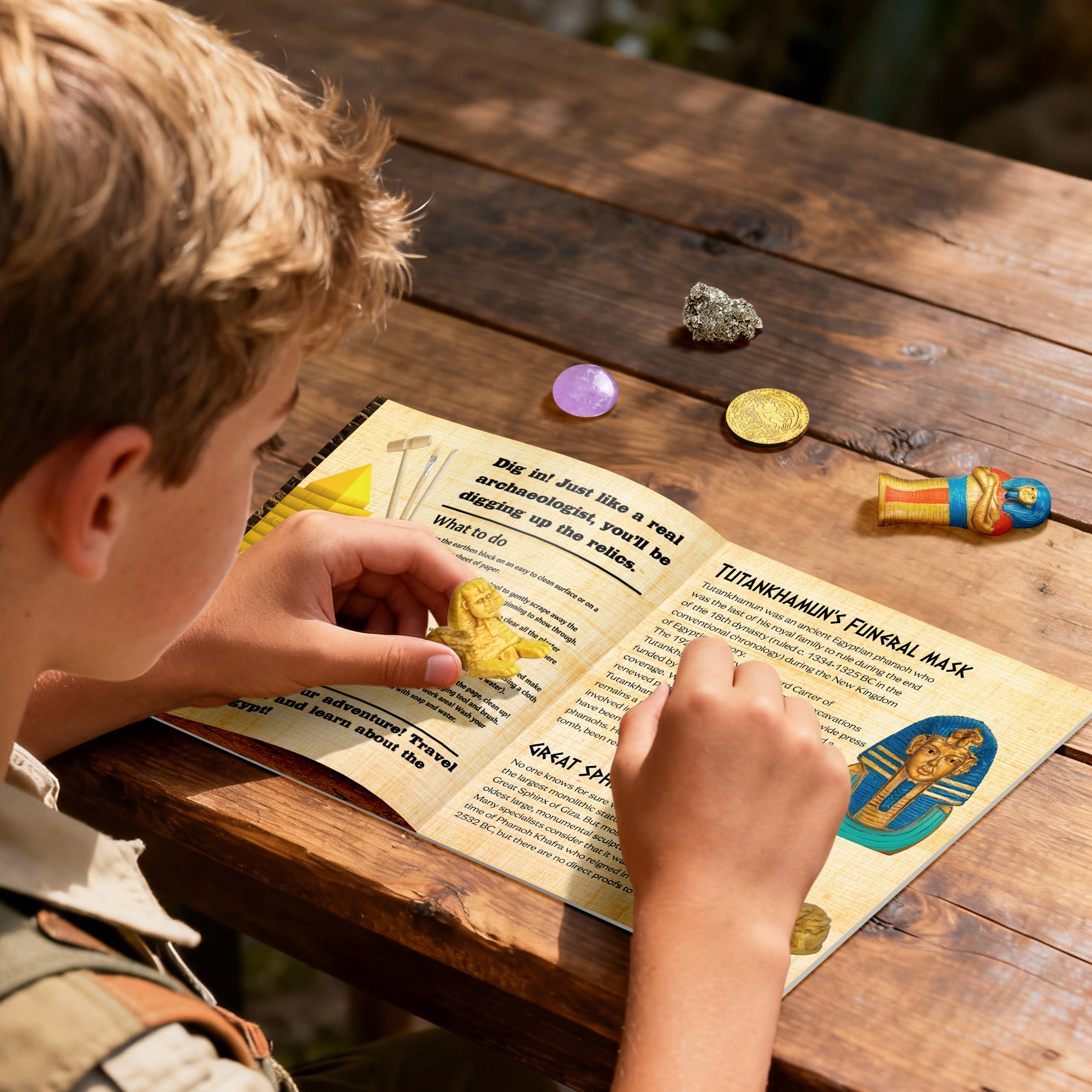
Dig kits usually hide fossils, imitation bones, rocks, minerals, gemstones, shells, or figures inside a plaster-like block. Children chip and brush the material away with the supplied tools.
The Dino Egg Excavation Kit includes 12 separate eggs, dinosaur figures, and learning cards. The cards give the child something to do after the digging: identify what they found.
The Crystal Night Light Dig Kit contains six named crystals in one excavation block. After the stones are uncovered and cleaned, the child can place them on a USB-powered display base.
Once the digging is over, compare the specimens by:
- color;
- shape;
- surface texture;
- visible grain;
- layers or markings;
- transparency or translucency.
Ask the child to put two specimens in the same group and explain why. “Both are translucent” gives you an observable rule. “I like these two” is a preference, not a classification rule.
A useful identification guide should show characteristics the child can actually inspect. If it only has a name and a picture, the task becomes simple picture matching.
Piano Potato’s guide to using dinosaur egg dig kits as an investigation adds prediction, measurement, observation, classification, and recorded evidence to the excavation itself.
A toy excavation is not the same thing as professional paleontology or archaeology. Archaeologists record where an object was found and how it relates to surrounding material because removing an artifact without that context can destroy useful information.[2]
A dig kit can still teach careful uncovering, observation, and recording. It just does not reproduce the geological or archaeological context of a real site.
Before buying, check three practical issues:
- Small pieces: stones, figures, fragments, and accessories may be a problem around younger siblings.
- Dust: dry excavation material can turn into loose powder. Use a tray or washable surface and follow the cleanup instructions.
- Tools: check the age guidance and supervision instructions for scrapers, chisels, hammers, or similar tools.
An Experiment Kit Should Test Something That Can Change
A simple comparison experiment changes one condition and compares the results while keeping the rest as similar as possible.
For example:
- two ramp heights;
- different amounts of water;
- different materials;
- different object shapes;
- different light conditions;
- different loads on the same structure.
If five things change at once, it becomes hard to tell which change caused the result.
Demonstration: add the supplied material and watch something happen.
Comparison experiment: repeat the procedure under defined conditions, observe or measure the result, then compare it.
The National Academies lists asking questions, planning investigations, analyzing data, constructing explanations, arguing from evidence, and designing solutions among the core practices used in science and engineering education.[3]
A children’s science kit does not need to behave like a school laboratory. It should still give the child something to investigate instead of only a list of steps to copy.
Do Not Choose an Experiment Kit by the Number Printed on the Box
A huge experiment count may include tiny variations of the same basic procedure.
Look through the activity list and ask:
- Do the activities investigate different questions or topics?
- Does the child measure or record anything?
- Can the activity be repeated under another condition?
- Does the manual explain what happened?
- Are several “experiments” really the same reaction with a different color or decoration?
Piano Potato’s comparison of science experiment kits and STEM building kits makes the distinction by activity. Experiment kits lean toward observing, measuring, comparing, and testing. Building kits lean toward making, testing, taking apart, and rebuilding.
Read the Contents List Before Buying
Many science kits still need household materials. Check both the box contents and the “you will also need” list before the activity reaches your table.
The Glowing Crystal Grow Kit, for example, lists two seed crystals, two powder bags, two growing cups, stirring tools, measuring equipment, and a UV light.
Crystal-growing projects include waiting time too. Instead of only looking at the final crystal, record changes in size, shape, coverage, or appearance at regular intervals.
Use the quantities and preparation steps specified in the kit. Changing them can change the growth and make the original instructions much less useful.
Volcano Kits Make Foam, Not Lava
A model volcano can show gas production, bubbles, foam, and flowing liquid. That foam is not molten rock.
The Glow Volcano Science Kit combines building and painting a model with a foaming eruption.
Piano Potato’s volcano experiment guide separates the home reaction from real volcanic processes and suggests measurements such as foam height, flow distance, and bubbling time.
Need kits for a school, camp, store, or group activity?
Send the target age group, preferred activity type, quantity, and destination market. Piano Potato can narrow the options to relevant dig, experiment, and craft formats instead of sending a long mixed product list.
Science Crafts Need More Than Decoration to Become a Science Activity
Science crafts often suit children who enjoy painting, molding, assembling, or building more than mixing chemicals or running experiments.
You can push the activity further by testing the finished object:
- compare how much weight two bridge designs can hold;
- fly several paper airplane designs under similar conditions;
- change a model boat after it tips over;
- compare the balance or movement of two structures.
If the child only decorates an object and reads a science fact afterward, it is mainly a craft. There is nothing wrong with that. It is simply a different activity.
The Arts & Crafts collection includes painting, molding, and build-and-paint projects.
The DIY Bird House Kit is a two-pack building and painting activity.
The Foil Rock Painting Kit includes 10 rocks and 10 stencils. Its main job is creative painting, not running a geology experiment.
What Does the Child Actually Do?
Look for one or more of these actions:
- ask or answer a question that can be tested;
- make a prediction;
- change one defined condition;
- observe or measure the result;
- compare results;
- sort objects using visible properties;
- change a design and test it again.
If none of those happen, the child is probably following a procedure rather than investigating a question.
Repeated trials matter when results can vary. A paper airplane flight, for example, changes with launch angle, throwing force, and air movement. One throw tells you very little. Several attempts under similar conditions give you something to compare.
| Trial | Design | Measured Result |
|---|---|---|
| 1 | A | Record result |
| 2 | A | Record result |
| 3 | A | Record result |
Adults should handle steps that are genuinely adult-only or beyond the child’s safe ability. Age-appropriate digging, measuring, sorting, assembling, recording, and comparing should stay with the child.
If the adult has to do nearly everything, the kit is probably too difficult.
Age Labels and Small Parts Matter
The U.S. Consumer Product Safety Commission advises adults to follow age guidance and safety information on toy packaging and choose products that match the child’s interests and abilities.[4]
Age grading may reflect:
- small-part size;
- tool design;
- materials or ingredients;
- reading difficulty;
- motor skills needed;
- adult-supervision requirements.
Do not hand a younger child an older-child kit just because an adult plans to sit nearby. The pieces or materials themselves may still be unsuitable.
U.S. small-parts rules specifically cover products intended for children under three. A part that fits entirely inside the standardized CPSC small-parts cylinder is treated as a small part under the regulation.[5]
Science kits for older children may contain stones, beads, screws, miniature figures, fossils, or electronic parts. Put loose pieces away where younger children cannot reach them.
Magnets, Batteries, Powders, and Experiment Materials
The American Academy of Pediatrics warns families about button or coin batteries, high-powered magnets, and other small objects that children may swallow or put into the nose or ears.[6]
For battery-powered kits:
- make sure the battery compartment closes securely;
- stop using the product if the compartment is damaged;
- keep loose and replacement batteries away from children.
If a kit contains loose magnets, count the pieces after use and store them separately rather than letting them disappear into a general craft box.
For powders and liquids:
- use the quantities and order stated in the instructions;
- keep packets labeled until you use them;
- do not mix leftovers unless the manufacturer gives instructions for that activity;
- never move unidentified materials into food or drink containers.
“Non-toxic” does not mean edible.
Craft Materials and U.S. Toy Testing
In the United States, art materials covered by the Labeling of Hazardous Art Materials Act must undergo chronic-hazard evaluation and carry applicable labeling. CPSC guidance also requires an ASTM D-4236 conformance statement where applicable.[7]
Follow the labels on children’s paints, clays, adhesives, and similar materials. Do not swap in adult hobby solvents, paints, resins, adhesives, or chemicals unless the children’s product instructions specifically say they are suitable.
Toys intended mainly for children age 12 and younger must be third-party tested by a CPSC-accepted laboratory and certified in a Children’s Product Certificate for applicable U.S. children’s product safety requirements.[8]
The exact requirements depend on the product, intended age, materials, and the sections of the toy standard that apply.
Piano Potato states on its Product Safety page that its testing program uses independent third-party laboratories and includes checks during different production stages. For a specific SKU, rely on the product documentation and the requirements of the destination market rather than a general company statement.
Need safety, packaging, or wholesale details for a specific SKU?
Send the SKU, target age group, destination market, and expected order quantity. Ask for age information, carton details, instructions, and available compliance documentation before confirming a retail or bulk order.
Separate Consumables from Reusable Tools
Piece count does not tell you how many times a kit can be used. Split the contents into things that disappear and things that stay.
Consumables may include:
- excavation blocks;
- powders;
- crystal-growing material;
- paint;
- paper;
- single-use ingredients.
Reusable items may include:
- measuring cups;
- droppers;
- brushes;
- magnifiers;
- molds;
- rulers;
- trays;
- building or circuit parts.
Reusable tools stay useful after the original consumables are gone.
Check whether another round uses ordinary household materials, manufacturer-approved refills, or a proprietary packet that only comes from one source.
Do not replace experiment chemicals with random household substitutes unless the instructions specifically say that substitution is appropriate.
Screen-Free Does Not Mean Screens Are Banned Forever
A book or reliable website can be useful after the hands-on activity. A child might look up a mineral, research an animal, or find out why an engineering design behaved the way it did.
Do the physical observation or test first. Use the screen later for questions the toy itself cannot answer.
That way, the device stays a reference tool instead of becoming a required part of the activity.
Check These Eight Things Before Buying
- Age: Does the manufacturer’s stated age range match the child?
- Activity: Does the child actually dig, test, measure, classify, build, compare, or redesign?
- Small components: Are there choking hazards, magnets, or button batteries?
- Materials: Does the kit contain powders, liquids, craft chemicals, glass, pointed tools, heat, or electrical parts?
- Contents: What comes in the box and what has to come from home?
- Reuse: Which items get used up and which tools remain?
- Repeatability: Can the activity be repeated with approved refills or permitted household materials?
- Adult role: Which steps need adult help or supervision?
Finally
Start with the way the child likes to play. Dig kits work best when the activity continues into identification or classification. Experiment kits should give the child something real to observe or compare. Science crafts become more STEM-focused when the finished object can be tested. Avoid products with vague age information, unclear materials, weak safety instructions, inflated activity counts, or nothing meaningful for the child to do beyond copying steps.