
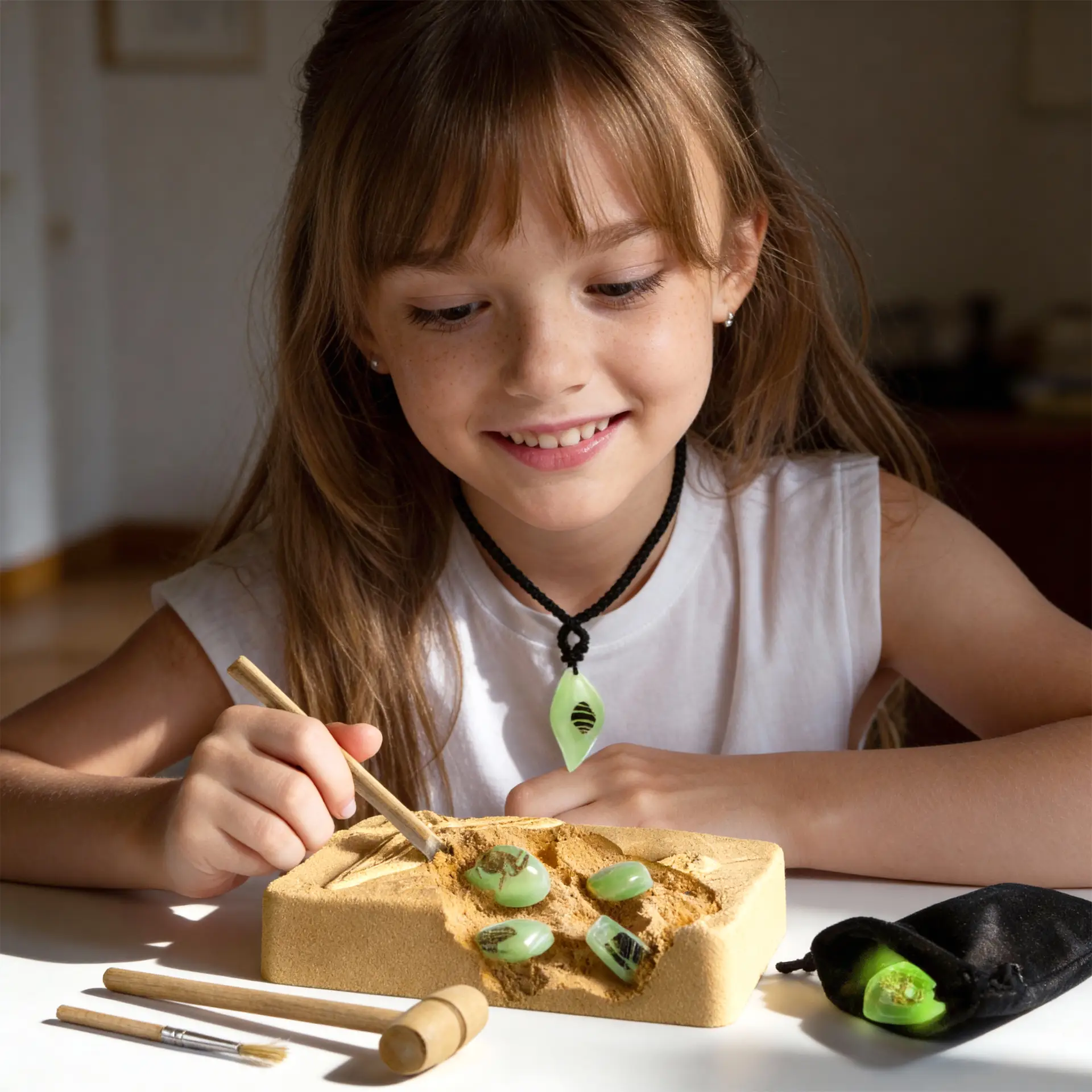
A children’s gemstone dig kit turns a simple plaster block into a small treasure hunt. Stones are hidden inside, and children use basic tools to uncover them one by one.
The 12-piece genuine birthstone dig kit is sold as a set of 12 real birthstones hidden inside a birthday-cake-shaped digging block. The kit includes a hammer, chisel, brush, birthstone poster, and DIY necklace supplies.
The excitement comes from not knowing where the next stone is hidden. But the science value starts after a stone appears: children can look at it closely, compare it with other specimens, describe what they see, ask questions, and try to identify it.
These simple actions are similar to several science practices described by the National Academies, including asking questions, carrying out investigations, using evidence, and building explanations.[1]
The treasure hunt gets a child interested. Looking closely, comparing stones, and asking questions are what turn the activity into a science experience.
A gemstone dig kit is not a replacement for geology lessons. Its value is simpler: it gives children real objects to examine and a reason to ask questions about colour, hardness, shape, transparency, and other properties.
The Joy of Digging
Hidden Stones Inside
One of the first questions many parents ask is simple: are the stones real?
The 12-piece birthstone kit is sold as a set of 12 real stones linked to the months of the year, with examples including garnet, amethyst, bloodstone, and crystal quartz.
Natural rough stones do not always look neat or perfectly polished. They may have:
- irregular edges;
- small pits or cavities;
- inclusions inside the stone;
- areas of different colour;
- rough or broken surfaces; and
- natural differences in size and shape.
Two stones with the same name do not have to look exactly alike. Natural variation is normal. A small rough specimen used in a children’s science kit should also not be confused with a cut and polished jewellery-grade gemstone.
In three internal family-experience days at the PianoPotato showroom in Guangzhou, 45 children from different age groups used bricks from the same kit model. The recorded successful-extraction rate was 87%. Six of the 45 children, or about 13%, scratched a stone while digging, and four of those six children were in the 6-year-old group.
These figures are internal observations from the participating group. They should not be treated as universal results for every child or every digging session.
A scratch is also not proof that a stone is natural. Natural minerals, glass, resin, and synthetic materials can all be scratched under the right conditions.
A better question is: what can I actually observe about this stone?
Useful clues can include:
- colour;
- lustre, or how the surface reflects light;
- transparency;
- visible bands or layers;
- hardness;
- surface shape; and
- the way a broken surface looks.
Amethyst is a purple variety of quartz with a Mohs hardness of 7.[2] A child can hold a rough amethyst, turn it under the light, compare it with another specimen, and notice differences that are harder to understand from a picture alone.
In three showroom cases, 6-year-olds returned to the same digging activity 20 to 30 minutes after finding their first specimen because they wanted to continue searching. Similar behaviour was seen in family panels held in 2023, 2024, and 2025.
Touching a stone does not automatically mean a child has learned geology. A stronger learning moment starts when the child begins asking questions such as:
- Why is this stone purple?
- Why does another stone have bands?
- Why is one transparent while another is opaque?
- Why does one surface scratch more easily than another?
A simple way for parents to help is to place two newly found stones side by side and ask for one similarity and one difference before giving the child the answer.
The 12-piece birthstone kit offers a smaller introduction to digging, while the 18-piece gemstones and crystals science kit expands the activity to 18 gem treasures and includes a full-colour guide covering gem formation, excavation, and specimen identification.
Real Tools, Not Toys
The 12-piece birthstone kit includes a hammer, chisel, and brush. Each tool has a different job:
- Hammer: helps apply force to the chisel.
- Chisel: focuses that force on a small area of the digging block.
- Brush: removes loose material around a partly exposed stone.
Using several tools makes the activity more varied. A child has to decide when to tap, when to scrape, and when to brush instead of repeating one movement from beginning to end.
Younger children may need an adult to loosen a difficult section, show a safer tool angle, or divide the activity into shorter sessions. Older children may be able to work more independently and spend more time comparing the stones they find.
Age labels are useful, but children of the same age can have very different levels of hand strength, patience, and tool control.
Children who already enjoy basic excavation activities can try a different theme, such as the life-size dinosaur fossil dig kit. A change in subject can also lead to different questions, such as “Is this a real fossil?” or “How old could it be?”
Safety standards should be described carefully. In the United States, ASTM F963 covers many toy-safety requirements, but not every part of the standard applies to every toy. The exact requirements depend on the product.[3]
The PianoPotato product-safety page describes the company’s testing programme, including the use of independent third-party laboratories. Parents who need current documents for a specific product can also use the how-to-order page.
Passing a safety test does not mean a toy is safe under every kind of misuse. Parents should still:
- follow the age recommendation and instructions for the exact kit;
- supervise children who cannot yet control the hammer or chisel confidently;
- keep small stones away from children who may put objects in their mouths;
- keep tools pointed away from the face and other people; and
- pause the activity if a child becomes tired and starts using the tools carelessly.
Digging blocks can also create loose pieces and dust. A tray or easy-to-clean work surface can make the activity easier to manage. After digging, loose material should be cleaned away and hands should be washed before eating.
The Surprise Reveal
The most exciting moment is usually when part of a hidden stone first appears.
The experience can be understood in three simple stages:
- “I found something.”
- “What kind of stone is it?”
- “What can I learn about it?”
The birthstone theme adds a cultural story to the activity. GIA describes birthstones as a popular introduction to gemstones and notes that they carry different stories, traditions, and meanings.[4]
It is useful to keep two ideas separate. Mineral identification is based on physical properties and evidence. Birth-month meanings come from cultural traditions.
In internal showroom observations involving 60 children aged 7–10, average excavation times were recorded as follows:
| Extraction milestone | Average time |
|---|---|
| First stone | 3.2 minutes |
| Sixth stone | 18.7 minutes |
| Final stone | 41.5 minutes |
The later part of the activity is not necessarily less interesting. By then, children may have learned how hard to tap, when to switch tools, and how to compare a new stone with one they have already found.
In the same internal panel, about 78% of families kept the twelve stones in a small home collection for an average of 4.3 months.
One 7-year-old in the 2024 sample found all 12 stones in 38 minutes, asked five follow-up questions about the birthstone associations for January and February, and continued looking at the collection over the following months.
After the final stone is found, the activity does not have to end. Children can:
- sort the stones by colour;
- sort them again by transparency;
- compare two stones that look similar;
- look for bands, inclusions, and rough surfaces; or
- make a simple card showing the stone’s name and one observed feature.
Families looking for a longer activity can also explore the 7-mineral crystal growing and dig combo kit, which adds crystal growing after the excavation stage.
Science Becomes Simple and Concrete
Rock Names That Stick
The main science value of a dig kit is not simply remembering names. It is learning to look at an unfamiliar specimen and ask what evidence could help identify it.
A simple beginner’s process is:
- Look at the stone before naming it.
- Describe what you can see.
- Compare it with another specimen or reference picture.
- Check other useful properties.
- Record the answer, including any uncertainty.
Useful clues include:
- Colour: What colour or colours can you see?
- Lustre: Does the surface look glassy, dull, waxy, pearly, or metallic?
- Transparency: Can light pass through the stone?
- Banding: Are there visible stripes or layers?
- Surface shape: Is it smooth, rough, flat, curved, or uneven?
- Hardness: How easily can the specimen be scratched?
No single clue always gives the correct answer. Colour is useful, but two different minerals can look similar, and the same mineral can appear in different colours.
The 12-piece birthstone kit includes a birthstone poster, while the 18-piece kit includes a fuller colour guide for identifying specimens. Families who want a larger collection for comparison can also explore the 250-stone mineral collection kit.
The PianoPotato brand story page gives more background on the company’s focus on educational toys, rocks, minerals, fossils, and hands-on science activities.
Seeing a name once is usually less useful than working with the same idea several times. Comparing a new stone with something already learned, trying to remember its name later, and using the information again can help make learning more meaningful. The National Academies’ review of learning research covers the importance of memory, prior knowledge, active learning, and the way new knowledge is built across both formal and informal settings.[5]
A guide is most useful when it helps a child check the evidence, not when it simply gives the answer immediately.
Colour as a First Clue
Colour is often the first thing children notice because it is easy to see and describe.
Amethyst, for example, is the purple variety of quartz.[2]
But colour alone is not enough for a reliable mineral identification. The same mineral may appear in several colours, while different minerals may look very similar.
Use colour to make a first guess, then look for one or two more clues.
Instead of saying:
“It is amethyst because it is purple.”
A child could say:
“I think it may be amethyst because it is purple, partly transparent, and has a glassy-looking surface.”
The second answer is better because it explains the reason behind the guess.
After the excavation, children can use colour in simple comparison activities:
- place three stones from lightest to darkest;
- group stones into similar colours;
- compare a real stone with a reference picture; or
- sort the same four stones once by colour and again by transparency.
The last activity shows an important idea: the same objects can be grouped in different ways depending on the property being studied.
Families who want to connect stone observation with an art activity can also explore the mandala rock-painting kit.
The Hardness Test
After colour and surface appearance, hardness gives children another useful clue.
The Mohs scale ranks ten reference minerals from talc at 1 to diamond at 10. A harder material can scratch a softer one, which makes scratch testing a simple way to compare mineral hardness.[6]
Common approximate references include:
| Reference object or mineral | Approximate Mohs hardness |
|---|---|
| Fingernail | About 2.5 |
| Copper coin | About 3 to 3.5 |
| Glass | About 5.5 |
| Quartz | 7 |
The Mohs scale is not linear. A mineral rated 8 is not simply twice as hard as one rated 4.
Household objects are also only rough references because their exact material and hardness can vary.
Scratch testing can leave a permanent mark, so it should be done carefully on a small, less visible part of a specimen. Children who want to keep a stone unchanged can start with non-damaging observations such as colour, lustre, transparency, and visible banding.
In an internal PianoPotato activity conducted in November 2024 with 45 eight-year-olds, children using a simple fingernail, coin, and glass comparison test correctly sorted amethyst, calcite, and talc 71% of the time. The comparison group, which did not use the test objects, scored 32%.
| Group | Correct sorting rate |
|---|---|
| Children using three comparison tools | 71% |
| Comparison group without the tools | 32% |
| Observed difference | 39 percentage points |
This was an internal activity, not an independent scientific study. The result describes that particular group and should not be treated as a guaranteed learning improvement for every child.
For home use, the main point is simple: a child can make a better guess when visual observation is combined with another physical property.
The 36-piece real rock and gemstone collection kit offers a larger set of rocks, gemstones, and crystals together with a child-friendly identification guide and activity book.
Families who need exact information about dimensions, packaging, or shipping weight for a specific kit can check the PianoPotato contact page rather than assuming that specifications for one product apply to another.
What Children Actually Take Away
Focused-Time Spans
One practical question matters to many parents: how long will a child actually stay interested?
An internal PianoPotato comparison involving 120 families in Q4 2024 reported the following average focused times:
| Activity or age group | Average focused time |
|---|---|
| 12-piece birthstone kit overall | 38 minutes |
| Ages 6–8 | 31 minutes |
| Ages 9–12 | 47 minutes |
| Comparably priced construction sets in the internal comparison | About 19 minutes |
| Comparably priced painting sets in the internal comparison | About 22 minutes |
These figures describe what happened in that internal comparison. They do not prove that one digging session permanently improves a child’s attention span, concentration, or school performance.
A fair comparison between activities would also need to consider:
- the children’s ages;
- how new the activity was to them;
- how much help adults provided;
- the activity setting;
- previous experience; and
- how “focused time” was measured.
For parents, the practical lesson is more useful than the exact number. Some children may enjoy one long session, while others may do better with several shorter sessions.
A simple plan is:
- Find three or four stones.
- Stop and clean them.
- Compare or draw one specimen.
- Return to the digging block later.
Families looking for another structured treasure-hunt activity can also explore the 12-piece pirate treasure dig kit.
Parents should watch the child’s behaviour rather than focusing only on the clock. It may be time for a break if the child:
- starts hitting harder without control;
- asks an adult to do every step;
- repeatedly leaves the work area;
- rubs tired hands; or
- becomes increasingly upset because the next stone does not appear quickly.
Stopping after four stones is not a failure. A shorter session can be better if the child comes back later still wanting to continue.
Hands-On Play
A gemstone dig kit involves several small, controlled hand movements:
- gripping a hammer or brush;
- holding a chisel steady;
- controlling how much force to use;
- picking up a small specimen;
- turning a stone to look at different sides; and
- using both hands together during digging and cleaning.
These actions use fine-motor and hand-eye coordination, but a digging kit should not be described as a treatment or as proof that one session permanently improves a child’s motor development.
Children develop at different speeds. The CDC notes that developmental milestones give a general idea of what to expect, but children reach skills at their own pace.[7]
A child with less hand strength may benefit from:
- a shorter session;
- an adult loosening a difficult section;
- more brushing and less hammering; or
- taking turns with an adult.
A child who dislikes the feel of dust may prefer gloves. A child who dislikes scraping sounds may do better with shorter sessions and a cleaner work area.
Success does not have to mean finishing the whole block alone. A child who notices a real difference between two stones, asks a useful question, or correctly identifies one specimen has also done something meaningful.
Parents comparing different types of hands-on activities can look at the 6-piece amber sea-life fossil dig kit or move into a different type of hand task with the 3D paper-craft kit.
The materials are different, but both kinds of activity can involve careful gripping, positioning, visual control, and patience.
Families can compare more products and age ranges through the full product catalogue.
Pride That Lasts
After a child has found twelve stones, the finished collection can become part of the experience.
“I found this stone, I compared it with others, and I can tell you something about it.”
Self-Determination Theory describes autonomy, competence, and relatedness as three basic psychological needs connected with motivation and well-being.[8]
- Competence: feeling able to complete a manageable challenge.
- Autonomy: having some real choice over what to do and how to do it.
- Relatedness: sharing an experience with someone who shows interest and support.
A dig kit can give children opportunities to experience all three. A child can choose where to dig, complete a clear task, and share the finished stones with a parent, friend, or teacher.
That does not mean every completed kit will create a lasting interest in science. Children have different interests, and no single toy can decide how they will feel about STEM in the future.
A better goal is to make the child’s work visible without turning the activity into a test.
Instead of asking only:
“How many stone names can you remember?”
A parent can ask:
“Which stone surprised you most, and what did you notice about it?”
Three simple things can help keep the collection useful after the digging is finished:
- Line up the 12 stones and photograph them.
- Write the name and one visible feature of each stone.
- Keep the collection somewhere visible for a while.
The PianoPotato blog also includes ideas for displaying specimens at home.
A simple specimen card can include:
- the stone’s name;
- one visible feature;
- one property checked with a guide;
- one unanswered question; and
- the date it was found.
A week later, a parent can choose three stones at random and ask the child to identify them without reading the labels. A month later, the same stones can be sorted in a different way.
This gives the same collection more than one use without requiring another purchase.
Readers who want more company background can use the PianoPotato about page, while current order information is available through the how-to-order page.
The shipping information page states that most items ship within one business day after successful payment processing. This refers to dispatch time, not a guaranteed delivery date.
Children who want to continue exploring rocks and crystals can also move on to activities such as the 7-real-geode cracking kit or the crystal growing kit.
Gemstone dig kits also have clear limitations:
- the digging material can be messy and dusty;
- some children may find repeated digging tiring;
- younger children may need a lot of adult help;
- natural stones can vary in colour, size, and appearance;
- poor tool control can scratch a specimen; and
- finding every stone does not automatically create deep geology knowledge.
These limits do not remove the value of the activity. They simply help parents know what to expect.
A gemstone dig kit works best when finding the stone is the start of the question, not the end of the activity.
The treasure hunt gives children a reason to begin. The stones give them something real to examine. Looking closely, comparing what they find, and asking simple questions can turn that excitement into a more meaningful science experience.