
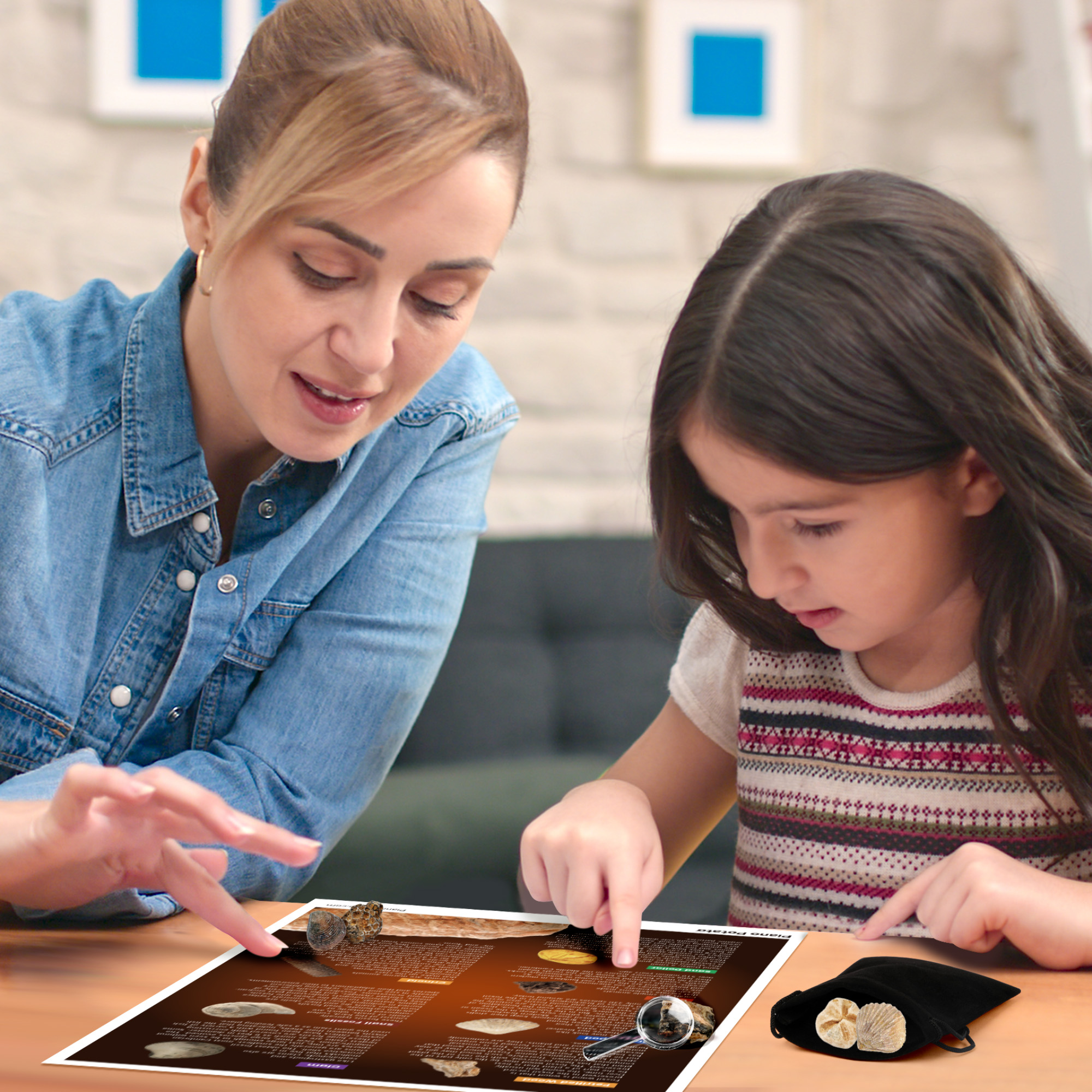
Real specimens make a handling collection. Replicas make a scale model. That’s the choice. Real pieces sort, weigh, and compare, and single pieces run $2 to $9.
Two checks separate them before you pay. The label should show a species name and a formation, and the instructions should say cast or replica if that’s what’s inside.
Age sets the floor[1]. Nothing under 3 may contain small parts, kits actually start at 6, and the metal tools wait until 8. Spending runs from $10 for one round of chipping to $60 and up for a display piece.
Almost every real specimen you’ll meet is a common invertebrate or plant fossil. Sizes span 2 to 10 cm. Weights span 5 to 120 g. The gap is 24-fold.
Fossils pulled from federal land never reach the retail channel. Casual collecting is capped at 25 lb per person per day[2]. National Forest land uses a different pair of numbers. The cap there is 100 lb per calendar year, no more than 25 lb in a day[3]. Spread that 100 lb across 365 days and you’re left with 0.27 lb a day. Four full days of collecting use up the whole year.
Resin casts can do what rock can’t. A mold delivers a 1:1 T. rex claw or Ankylosaurus spine, and pieces go past 20 cm. Real specimens stop at the 10 cm ceiling. You don’t get to swap one for the other.
Real specimens are limited by law
The Interior Department splits paleontological resources into two tracks. Common invertebrate and plant fossils are open to permit-free collecting, and they’re the ones you’ll actually see in a kit. Vertebrate fossils need a permit[4].
43 CFR 49.810 caps permit-free collecting at 25 lb per person per day, or 11.34 kg. One pound is about 0.4536 kg. At 20 g per shark tooth, that’s 567 teeth on paper. Complete specimens are under 1% of what comes out of the ground. Surface picking only, or non-powered hand tools.
A fossil specimen embedded in rock can come out whole. Slabs over 25 lb are allowed for that reason, to keep the fossil intact[2].
36 CFR 291.5 caps fossil collecting at 100 lb per calendar year, or 45.36 kg, with a 25 lb daily cap. Four full days at the daily cap and the year is gone. National Forest land is casual-collecting only. Anything past the cap needs a permit[35].
43 CFR 49.300(a)(3) covers selling, buying, and even offering a trade in fossils. Knowing and should-have-known both count.
A person may not sell or purchase or offer to sell or purchase any paleontological resource if the person knew or should have known such resource to have been excavated, removed, sold, purchased, exchanged, transported, or received from Federal land.
That’s why California shark teeth, Moroccan ammonites, and trilobites reach the market from quarries, private land, or mines abroad. You can’t verify where any single fossil came from. What you can verify is whether the seller printed a species, a locality, and a formation[6].
Fossils you can buy legally
- Shark teeth, common in Miocene beds, 2 to 8 cm each, 5 to 30 g.
- Ammonites, mostly Morocco and Madagascar, 2 to 30 cm across.
- Trilobites, Morocco produces the most, complete ones reach 3 to 8 cm.
- Brachiopods and bivalves, common in European and North American quarries.
- Amber with insect or plant inclusions.
- Petrified wood, big pieces, low unit price, a block can pass 1 kg.
A retail kit with 5 real fossils rarely goes past 12 pieces. Pieces span 2 to 10 cm. The whole box stays under 200 g. That works out to 40 g per piece.
Where the supply comes from
Quarries move overburden by the ton, and fewer than 5 complete specimens come out of a tonne. The leftovers go into 20 to 50 kg bags for the craft trade, and private landowners work their own shallow ground. Overseas mines are the third source, and Moroccan and Malagasy ammonites travel that route. None of the three can produce a government permit, and none needs one.
Replicas come out of a mold
A replica starts as a silicone mold pulled off a real specimen, then gets filled with resin or plaster. A mold wears out like a tire. Somewhere between 20 and 50 pulls it starts losing detail. A 500 g mold costs $30 to $80. Per piece, cost drops below $1.
Skeleton kits get molded in pieces, so a kid can dig them out and rebuild a 10-piece woolly mammoth skeleton.
A resin replica takes on under 1% water. A drop on the back won’t spread. Density reads 1.1 g/cm³, and a dropped piece usually just loses a corner. Plaster measures about 2.3 g/cm³ and absorbs over 20% water. A drop spreads within 3 minutes, and a break leaves white powder.
Replica casts show a parting line, usually 0.1 to 0.5 mm wide. Molds need a split plane, and the tight curves at claw tips and bone seams show it first.
What you guard against with a replica is small debris. A dropped resin piece can leave shards under 5 mm. Check the kit instructions for debris handling and age range before you buy[7].
ASTM F963-23 covers toys for kids under 14 and sets separate requirements for small objects, accessible sharp edges, accessible sharp points, and material quality.
Resin versus plaster
| Check | Resin cast | Plaster cast | Real specimen |
|---|---|---|---|
| Specimen weight at the same size | Lightest | Middle | Heaviest |
| Replica behaviour after a drop | Chipped corner | Cracks through | Breaks along an existing fissure |
| Replica fresh break surface | Smooth, tough | White powder | Mineral grain or dense bone |
| Specimen surface giveaway | Visible parting line | Visible parting line | No parting line |
| Replica reaction to a water drop | No absorption | Spreads | Depends on the mineral |
Pick up two same-sized pieces, one in each hand. Density doesn’t lie. Real fossils feel heavier. Surrounding rock averages about 2.5 g/cm³, so a resin copy weighs 40% to 50% less. Your hand catches that. No tools needed.
Why the parting line gives it away
Switch on your phone flashlight and rake it across the surface at about 30 degrees. A cast’s parting line forms one unbroken straight or curved line, with texture slightly out of register on either side. Real fossil texture scatters. It won’t break along a single tidy line.
Comparing the two kit types
| Comparison | Real-specimen kit | Replica kit |
|---|---|---|
| Kit piece size | Mostly 2 to 10 cm | Can reach 1:1 life size |
| Kit piece count | 5 to 12 | 2 to 12, skeleton kits 10 and up |
| Kit assembly value | None, each piece stands alone | Mostly parts, rebuildable after digging |
| Kit label requirement | Species and locality, or no collector value | Original specimen and holding institution |
| Kit break debris | Mineral, blunter edges | Resin or plaster, can produce shards |
| Kit handling value | Handle, compare, sort, repeat | Mostly a one-time dig |
| What the kit builds | Classification and comparison | Sense of scale and form |
Bare pieces labeled only fossil, with no species name, don’t have collector value. They sell for 30% to 50% below labeled equivalents.
Age is the first hard line
16 CFR 1500.18(a)(9) bans any toy for kids under 3 that presents a choking, aspiration, or ingestion hazard from small parts[1].
Kit testing goes through the small-parts cylinder in 16 CFR 1501.4, and the rule works in inches. The cylinder is 1.25 in (31.70 mm) across and 2.25 in (57.10 mm) deep[8]. A whole toy, or any piece that comes off in use-and-abuse testing, fails if it drops all the way in.
Debris from a dig kit and a snapped cast corner both fall in that category[9]. For this age, pick one-piece models in resin or wood, and cap the count at 6 or below. At 6, a hand grips a plastic chisel steady, though packed plaster takes repeated force and most kids quit before 3 minutes. Past 8, a child handles locating, chiseling, and cleaning alone. You’re left with table protection.
Under-six picks
Soften the kit’s plaster block with a damp cloth. Two to three minutes loosens the surface. Or pick molds wrapped in resin instead of packed plaster, and let your child peel open a 6-piece set with natural amber.
A 12-piece set gives 2.4 times the actions of a 5-piece one. Failure cost per piece drops from $9 to $0.80. Dig 2 or 3 at a time and it stretches across 4 to 6 sessions. Once a week, that’s over a month. At a 60 to 70 cm table edge, a 6- to 8-year-old can lean in and push.
Splitting the work past eight
Past 8, your child takes a metal tool while you step back to inspect the table and clean up. Packed fossil blocks average near 1.8 tonnes per cubic metre and need repeated strikes. An 8-year-old grip reaches about 30 N, enough for 20 to 40 swings.
Go with fewer pieces here. A 5-piece real fossil kit takes 30 to 60 minutes to finish. That’s 6 to 12 minutes per piece. Harder than 12 small ones, and far more likely to survive the week.
Tools decide whether anything opens
Tool material, hammer count, and goggles decide whether a kit opens at all. A too-light hammer just polishes the rock. A metal hammer cracks the rock, 20 to 40 strikes per block. The trade-off is that you stay in the room throughout.
Hammers and brushes
A kit with a heavier head needs less swing, and kids’ wrists lose force early. A 100 g head beats a 300 g one here, and the swing drops from about 15 cm to 8 cm. Bristle stiffness and brush width set how fast cleanup goes. A brush under 10 mm reaches into bone seams, and one over 25 mm clears powder across a wide face.
The one item that gets cut
Fossil chips and plaster dust both fly upward. Your eyes are under half a metre from the strike point. Goggles cost less than anything else on the parts list, at $2 to $3. Write them in. The geodes kit with goggles and a magnifier ships that way as standard.
Where the real safety risks live
Edges are the first risk with a fossil. A great white and tiger shark tooth set brings serrated edges, 3 to 7 cm per tooth. Bivalves bring shell margins. Ammonites often arrive with a broken aperture.
Cracking the rock around a fossil releases fine particles, down to 5 µm or smaller. A 200 g block yields about 30 g of debris. Lay down newspaper or a tray.
Coatings on a kit fall under 16 CFR 1303.1, and it’s a hard number. Paint and similar surface coatings over 0.009% lead are banned[10]. That’s 90 ppm. One ppm equals 0.0001%.
The 0.009% lead line for kit coatings took effect on August 14, 2009. The old limit was 0.06%, or 600 ppm. The new number is 15% of the old one. Fold those together and you get a 6.7-fold cut.
Europe runs a different track for the same kit. The European Commission lists the EN 71 series as harmonised standards, and the series reaches Part 14. EN 71-3 alone tracks limits for 19 migratable elements. Meet EN 71 and you’re presumed to meet the Toy Safety Directive 2009/48/EC[1112].
Europe’s rapid alert system pulls non-food consumer products off shelves and publishes them. In the UK, OPSS handles market surveillance. The same fossil kit needs a different set of paperwork in each market[1314].
Sharp edges and dust
Sweep the back of your hand along the specimen edge first. If it catches, sand it. An 80-grit paper (about 180 µm) takes the burr down, then 400-grit (about 35 µm) with 5 to 10 light strokes in one direction. Dust control needs 2 habits. Leave the table damp while striking, and wipe with a damp cloth instead of blowing.
Which compliance papers you need
A coating test report is one. The age-label basis document is the other. Miss 1 and retail shelves close. One third-party test round costs $500 to $1,500 and takes 2 to 4 weeks. Full-scope testing eats 3 to 5 finished kits as samples.
16 CFR 1500.83(a)(23) leaves a labeling exemption open to chemistry and science education sets. The catch is that every hazardous chemical’s immediate container must print the chemical name. Fossil dig kits don’t qualify[15].
Cross-border wholesale of fossil kits needs 2 sets of paperwork. The US tests to ASTM F963 and CPSIA. Europe tests to the EN 71 series. F963 covers 8 migratable elements. EN 71-3 covers 19. Test scope can double between the two. The site’s child testing program lays both tracks out side by side.
What you plan to do with it decides
Building a box you’ll pull out again and again points to real specimens. Showing a child the scale of an extinct animal points to replicas. Real fossils sort, weigh, and group by locality. Five to twelve pieces at $2 to $9 each build a locality-based collection. A 1:1 T. rex claw or mammoth skeleton only exists as a cast.
For a 6- to 9-year-old with a 10 to 20 minute attention span, a mixed kit wins. Three to six real fossils plus 2 to 4 resin specimens, dug a little at a time, keeps interest alive without one long session. A 15-piece set ships at about 400 g and delivers the full dig. A 250-piece bucket weighs over 2 kg and prices out under $0.20 per piece. A bucket like that is a sorting tray, not a dig.
Verifying a fossil on the spot
None of these 4 kit checks needs a tool. Two minutes covers all of them. Miss 1 and price it as a cast.
- Weigh two same-sized pieces by hand. Real fossils come in 40% heavier or more.
- Rake a phone flashlight across the surface. Look for one continuous parting line, 0.1 to 0.5 mm wide.
- Drop water on the back. Plaster bleeds a boundary within 3 minutes, resin doesn’t.
- Read the label for species, locality, and formation. All three or walk away.
What the label should say
Think of the label as the fossil’s passport. It needs 4 items. Species, locality, formation, piece count. Real specimens print a Latin name, like the extinct mackerel shark Otodus obliquus.
Pieces marked only fossil or natural fossil, with no species, are weight-sold bulk. Expect 30% or more off a labeled equivalent. Weigh it, then read the label. Museum-grade Otodus teeth over 12 cm fetch $100 each.
Price bands and piece counts
| Price band | Typical kit | Fossil count | What the child gets |
|---|---|---|---|
| Kit at $10 to $20 | Plaster block, plastic tools | 1 to 6 fossils | One round of chipping |
| Kit at $25 to $45 | Packed fossil block, metal tools | 5 to 12 specimens | A collection that lasts |
| Kit at $60 and up | Snap-together skeleton or full cast set | 10 or more bone pieces | A display piece |
At $25 to $45 you get 5 to 12 specimens, which works out to $2.10 to $9 per piece. At $10 to $20 you get 1 to 6, bottoming under $2 each. Past $60 the piece count climbs past 10. Single pieces start at $6. You’re paying for something that stands on a shelf.
Wholesale usually sells at 40% to 50% of retail. Check what’s inside before you argue price. A kit priced at $25 to $45 that ships one plastic hammer and three plaster blocks has a configuration problem, not a price problem. Next Generation Science Standards put fossils into a third-grade performance expectation[16]. Students analyze fossil data to infer the organisms and the environments behind them.
NSTA organizes classroom resources by grade band and topic, so you can check a kit against the grade list and see if it survives. A class of 25 burns through 3 to 4 kits a term. The site’s quality checklist asks the one question that matters. What’s left after three months? A plastic hammer rarely survives 20 strikes, while the specimens outlast it[17].
- 16 CFR 1500.18 — Banned toys and other banned articles intended for use by children — ecfr.gov. https://www.ecfr.gov/current/title-16/section-1500.18
- 43 CFR 49.810 — What is casual collecting? — ecfr.gov. https://www.ecfr.gov/current/title-43/section-49.810
- 36 CFR 291.5 — Paleontological Resources Preservation, Definitions — ecfr.gov. https://www.ecfr.gov/current/title-36/section-291.5
- 43 CFR Part 49 — Paleontological Resources Preservation, Subpart A — ecfr.gov. https://www.ecfr.gov/current/title-43/part-49
- 36 CFR 291.11 — Casual collecting on National Forest System lands — ecfr.gov. https://www.ecfr.gov/current/title-36/section-291.11
- 43 CFR 49.300 — What acts are prohibited? — ecfr.gov. https://www.ecfr.gov/current/title-43/section-49.300
- ASTM F963-23 — Standard Consumer Safety Specification for Toy Safety — store.astm.org. https://store.astm.org/f0963-23.html
- CPSC — Small Parts, 16 C.F.R. Part 1501 (consumer summary) — cpsc.gov. https://www.cpsc.gov/s3fs-public/Small-Parts-16-C-F-R-Part-1501-English.pdf
- 16 CFR 1501.4 — Size requirements and test procedure — ecfr.gov. https://www.ecfr.gov/current/title-16/section-1501.4
- 16 CFR 1303.1 — Scope and application — ecfr.gov. https://www.ecfr.gov/current/title-16/section-1303.1
- European Commission — Toys — single-market-economy.ec.europa.eu. https://single-market-economy.ec.europa.eu/sectors/toys_en
- Directive 2009/48/EC on the safety of toys — eur-lex.europa.eu. https://eur-lex.europa.eu/legal-content/EN/TXT/?uri=CELEX:32009L0048
- Safety Gate: the EU rapid alert system for dangerous non-food products — ec.europa.eu. https://ec.europa.eu/safety-gate-alerts/screen/search
- Office for Product Safety and Standards — gov.uk. https://www.gov.uk/government/organisations/office-for-product-safety-and-standards
- 16 CFR 1500.83 — Exemptions for small packages, minor hazards, and special circumstances — ecfr.gov. https://www.ecfr.gov/current/title-16/section-1500.83
- NGSS 3-LS4-1 — Biological Evolution: Unity and Diversity — nextgenscience.org. https://www.nextgenscience.org/pe/3-ls4-1-biological-evolution-unity-and-diversity
- National Science Teaching Association — nsta.org. https://www.nsta.org/
Wholesale and school programs hit two questions that decide whether a fossil dig kit can enter a market at all. Which standard the age label has to follow, and which sourcing documents real specimens and replicas each need. Exporting under HS 9503 is the easy part. A carton of 24 kits weighs 10 to 12 kg. Send your age band, target market, and quantity, and we’ll come back with a configuration list, label notes, and pricing.Send us your kit spec